

You won’t find the best deals on MLS listings with bright pictures and open house banners. By the time properties go public, many other investors have likely acted before you even noticed. If you want to grow your portfolio, learning how to find off-market property listings can give you an edge over other investors before they even realize what’s happening.
What Makes a Property “Off-Market”?

The term off-market refers to a property that is not publicly listed on the MLS or similar real estate sites. The owners may decide to sell their property discreetly or are only testing the waters for the time being.
These properties often come with less competition, more room to negotiate, and sellers who are motivated for reasons that have nothing to do with getting top dollar: inheritance, divorce, financial strain, or simply wanting a fast, hassle-free sale.
Why Off-Market Real Estate Deals Are Worth the Extra Effort
Chasing off-market real estate deals takes more legwork than scrolling listings, but the payoff usually justifies it:
- Less competition. Fewer eyes means fewer bidding wars driving up the price.
- More negotiating room. Motivated sellers are often flexible on price and terms.
- Better margins. Lower purchase prices leave more room for renovation budgets and profit.
- First access. You’re often the only offer on the table, not one of twenty.
Public listings are a numbers game. Off-market deals are a relationship game, and relationships tend to win.
Where to Find Off-Market Properties
Driving for Dollars
This old-school method still works. Drive through target neighborhoods looking for signs of neglect, overgrown lawns, boarded windows, piled-up mail. Track the addresses, then look up ownership records to reach out directly.
Direct Mail Campaigns
Regularly sending newsletters or postcards to owners of low-value or inherited properties is one of the best sources of leads imaginable. Although this method may not be very interesting, more often than not, consistency can win over creativity.
Networking With Wholesalers
Wholesalers are the experts in the field of buying properties under agreement and selling them to an investor. Developing relationships with a number of active wholesalers in your area will ensure a steady flow of leads.
Real Estate Investor Networks
Perhaps some of the best leads are never advertised; they are exchanged between friends amongst investors. This is the story of how real estate joint ventures begin: when an investor finds a deal too complicated or big to execute on their own, and contacts someone they can trust to go ahead with the deal together.
Online Platforms Built for Investors
Cold calling isn’t the only way to find off-market deals. Online real estate marketplaces focused on investors tend to feature properties that were never listed before, therefore uniting sellers, wholesalers, and investors together instead of leaving them to explore random messages in forums and groups.
Probate and Estate Sales
In most cases, properties in probate are sold without alerting many people, as families want to settle an estate without going through the hassle of doing a public sale. While probate attorneys and public records may provide some leads, this is a time-consuming and challenging path to take.
Tax Delinquent Property Lists
County records often include properties that owe money in taxes. Property owners in this kind of situation may want to sell the property as quickly as possible in order to avoid losses. Although this information is public, a lot of work has to be done to filter out repeat and useless leads.
Where to Find Off-Market Properties Without Wasting Time
Knowing where to find off-market properties matters less than knowing where to focus your limited time. Prioritize channels based on your resources:
- Low time, some budget: direct mail campaigns and online investor platforms
- Low budget, more time: driving for dollars and public record research
- Established network: wholesalers and joint venture partners
- Long-term play: building relationships at local investor meetups and events
Spreading yourself across every channel at once usually produces worse results than mastering one or two consistently.
Building the Relationships That Bring Deals to You
Off-market deals rarely land in your lap on the first try. They come from showing up consistently, at meetups, in conversations, through referrals. Attending real estate investing seminars puts you in a room with wholesalers, agents, and other investors who might have exactly the deal you’re looking for, long before it ever reaches an open market.
These relationships also tend to lead to joint ventures down the line, where two investors combine capital, experience, or connections to close a deal neither could handle alone.
Vetting an Off-Market Deal Before You Commit
Just because a deal is off-market doesn’t automatically make it a good one. Run every opportunity through the same filters:
- Verify ownership: make sure you’re negotiating with the actual owner, not a middleman with no legal claim
- Check comparable sales: confirm the discount is real, not just assumed
- Inspect before closing: off-market doesn’t mean skip due diligence
- Understand the motivation: knowing why someone’s selling helps you negotiate fairly and avoid legal gray areas later
A discounted price means nothing if the deal falls apart during due diligence.
Common Mistakes Investors Make Chasing Off-Market Deals
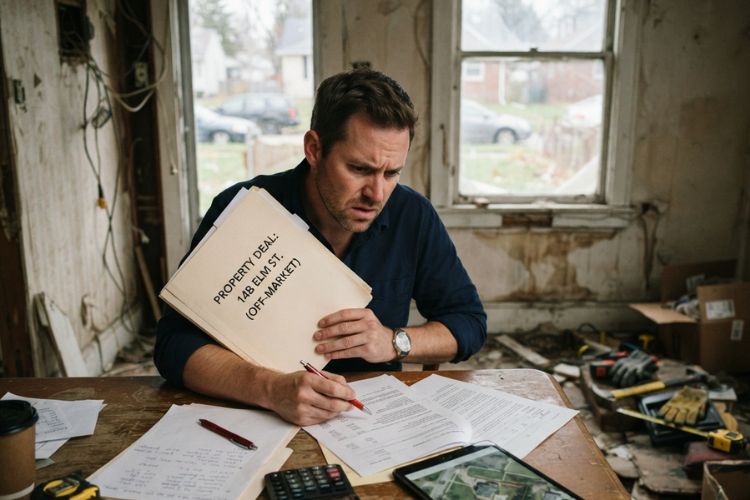
- Giving up too early. Direct mail and driving for dollars take repetition before results show up.
- Skipping the paper trail. Always confirm ownership and liens before getting emotionally invested in a deal.
- Overpaying anyway. “Off-market” isn’t automatically “discounted”; always verify against real comps.
- Ignoring legal boundaries. Some outreach methods (especially around distressed sellers) have local regulations; know them before you start.
Frequently Asked Questions
Are off-market properties cheaper than listed properties?
Often, but not always. Off-market deals can offer better pricing due to reduced competition and motivated sellers, though every deal still needs to be verified against local comps.
Is it legal to buy off-market properties?
Yes, buying off-market is completely legal. Just be mindful of local regulations around certain outreach methods, like door-knocking or specific direct mail practices in some states.
Do I need a real estate agent to buy an off-market property?
Not necessarily. Many off-market deals happen directly between buyer and seller, or through wholesalers, though an agent can still help with paperwork and negotiations if you prefer that support.
How long does it take to find a good off-market deal?
It varies widely; some investors land a deal within weeks through networking, while direct mail or driving for dollars campaigns often take months of consistent effort before producing results.
Final Thought
Off-market deals reward the investors willing to do the unglamorous work, building relationships, staying consistent with outreach, and showing up where deals actually get discussed. Master a channel or two, verify every opportunity honestly, and the properties nobody else sees will start finding their way to you instead.