

Two properties. Same price. Same neighborhood. One makes money, the other quietly drains it. The number that tells them apart? Cap rate.
If you’ve ever stared at a property listing wondering whether the price actually makes sense, cap rate is the shortcut that cuts through the guesswork. It won’t tell you everything, but it’ll tell you enough to walk away from a bad deal before you sign anything.
What Is Cap Rate, Really?
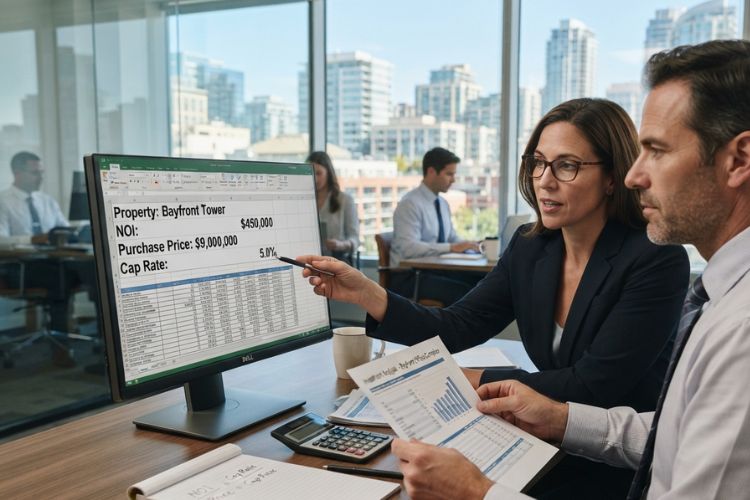
The capitalization rate, otherwise known as the cap rate, measures the income generated by any given property, irrespective of the method of financing used by the property owner. In other words, it removes elements such as the loan itself, down payment, and loan conditions.
Think of cap rate as a snapshot of a given moment. It shows how the property is performing, without any further specifics in the context of prices and currently existing income.
Investors use cap rate to:
- Compare properties against each other quickly
- Spot overpriced listings before wasting time on a tour
- Track how a market or neighborhood is trending over time
- Estimate roughly how long it’ll take to recoup an investment
The Cap Rate Formula
Here’s the part everyone actually wants:
Cap Rate = Net Operating Income ÷ Current Market Value
That’s it. No financing, no mortgage payments, no tax bracket. Just income against value.
Net Operating Income (NOI) is your total rental income minus operating expenses- think property taxes, insurance, maintenance, and management fees. It does not include your mortgage payment or capital improvements.
How to Calculate Cap Rate Step by Step
Knowing the formula and actually applying it are two different skills. Here’s how to calculate cap rate on a real property:
- Add up annual rental income. Include all units if it’s a multifamily property.
- Subtract operating expenses. Taxes, insurance, repairs, vacancy allowance, property management- everything except the mortgage.
- That result is your NOI.
- Divide NOI by the property’s current value (either the purchase price or appraised value).
- Multiply by 100 to get a percentage.
Quick example: a rental brings in $30,000 a year. Expenses run $10,000. That leaves an NOI of $20,000. If the property is valued at $250,000:
$20,000 ÷ $250,000 = 0.08, or an 8% cap rate.
Simple on paper. The tricky part is being honest about your expense estimates — underestimate them, and your cap rate looks better than reality.
What Is a Good Cap Rate?
This is where most new investors get stuck, and honestly, there’s no single right answer. What is a good cap rate depends heavily on the market, the property type, and your own risk tolerance.
Generally speaking:
- 4-5% is common in stable, high-demand metro areas where appreciation carries more weight than cash flow
- 6-8% is often considered a solid, balanced range for rental properties
- 9%+ usually signals higher risk; think secondary markets, older properties, or areas with more volatility
A high cap rate isn’t automatically a win. It can mean strong cash flow, or it can mean the property sits in a rough area with high vacancy and constant repairs. Context always matters more than the number alone.
Good Cap Rate for Rental Property: What Changes the Number
A good cap rate for rental property shifts depending on a handful of factors:
- Location. Coastal cities and major metros usually run lower cap rates because property values are high relative to rent. Smaller or emerging markets often run higher.
- Property condition. Newer or recently renovated properties tend to command lower cap rates since there’s less risk baked into future repairs.
- Property class. Class A properties (newer, prime locations) typically sit lower than Class C properties (older, higher-risk areas).
- Market cycle. Cap rates compress when demand is high and expand when the market cools off.
There’s no universal target. A 5% cap rate in a growing suburb might be a fantastic deal, while the same number in a declining market could be a warning sign.
Where to Find Cap Rate Opportunities
Investors can only apply cap rates after having investment properties to which to apply them. Checking a half-dozen unconnected websites would only confuse the process of comparison. If you have all the listings on one site, you can narrow them down based on price, location, and type of property.
It pays to consult with local experts: appraisers, property managers, and lenders, who could give you their opinions on your estimates of NOI.
Cap Rate Isn’t the Whole Story
Cap rate is a fantastic filter, but it’s not a decision-maker on its own. It doesn’t account for:
- Financing costs: your actual return (cash-on-cash) will differ once your mortgage enters the picture
- Future appreciation: a low cap rate area might still deliver strong long-term equity gains
- Value-add potential: a property with a mediocre cap rate today might have serious upside after renovations
Use cap rate to narrow your list, then dig deeper into cash-on-cash return, appreciation trends, and the local rental demand before making a final call.
Building Your Team Around the Numbers

However effective your cap rate calculation might be, it is still important to find experienced individuals who can help you corroborate your findings. Lenders may inform you of what lending will be like. Property management professionals are able to provide you with realistic numbers regarding vacancy rates. Contractors might be able to provide you with estimates for repair costs, which may otherwise exceed your initial NOI estimates.
Checking a business directory for vetted local professionals- lenders, inspectors, property managers- before you close can save you from a cap rate that looked great on paper but fell apart in practice.
Frequently Asked Questions
Is a higher cap rate always better?
Not at all. A higher cap rate reflects that a property is older, in a worse location, or has greater risks. In short, it’s a good reason to investigate more, not a reason to leap into an investment without further research.
Does cap rate include mortgage payments?
No. Cap rate considers only Net Operating Income, which excludes financing costs. This means that cap rate can be used to compare different properties without having to take into account how the property owner will finance his/her purchases.
How is cap rate different from cash-on-cash return?
Cap rate measures the profitability of a property, regardless of how it is financed. Cash-on-cash return takes into account your specific financing (the precise mortgage and down payment) and shows exactly how much money you can make from the cash you invested in the property.
Can cap rate change after I buy a property?
Yes, it does change over time, as rents, costs, or market value of the property fluctuate as well. In fact, increasing rents tend to increase cap rates, while increasing market values lead to a decrease in cap rate.
Final Thought
Although the cap rate is not going to give you the best deal possible, it will allow you to avoid time-wasting transactions that are obviously bad. Learn the cap rate formula, have a look at what is acceptable for your location, and use it as your first filter instead of your last before investing money.