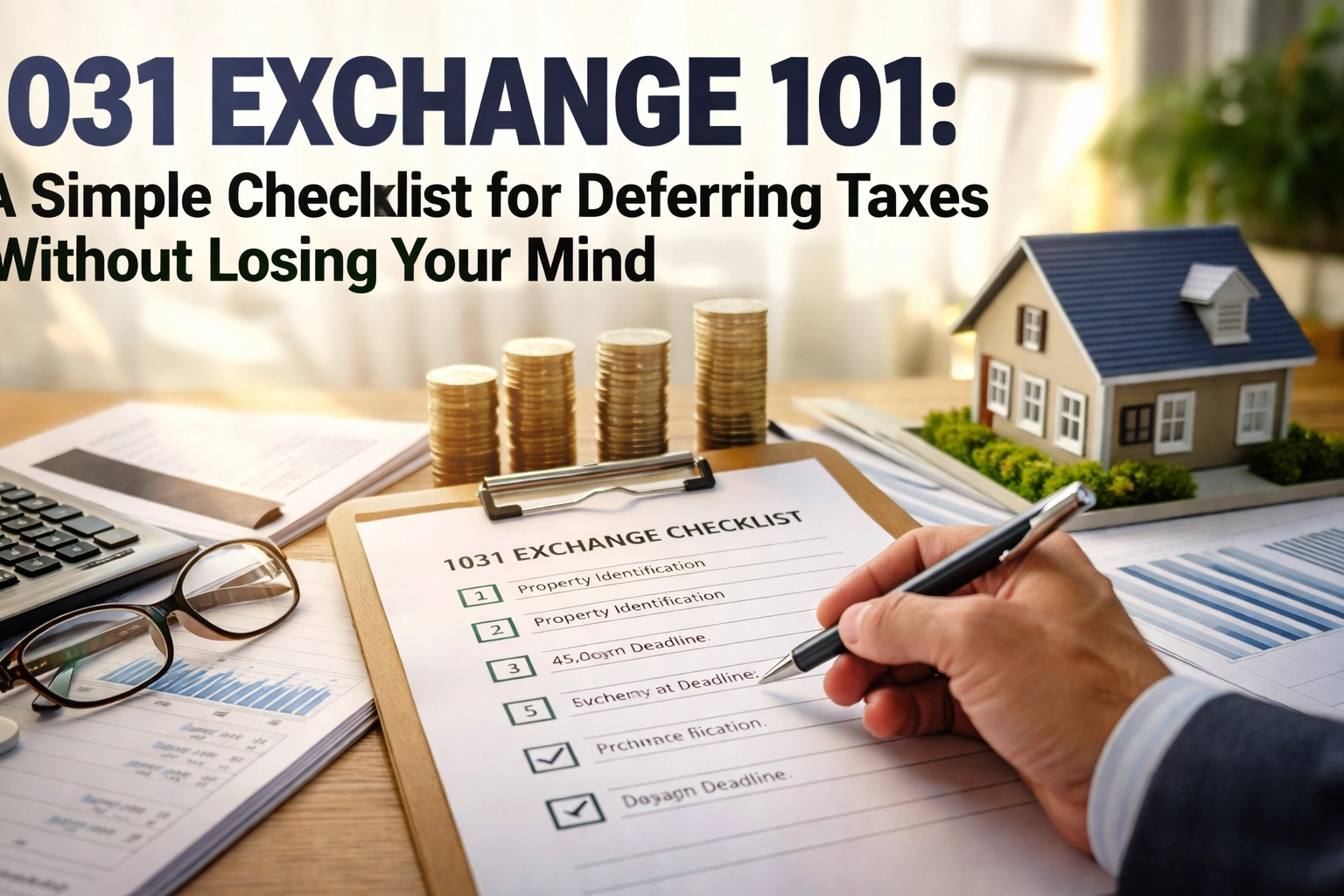
1031 Exchange 101: A Simple Checklist for Deferring Taxes Without Losing Your Mind

You just sold an investment property for a solid profit. The numbers look great on paper. Then reality hits: capital gains taxes are about to take a serious bite out of your returns.
Here is the good news. If you play your cards right, you can defer those taxes and roll your profits into another investment property. The strategy is called a 1031 Exchange, and it has been a cornerstone of real estate wealth-building for decades.
The bad news? The rules are strict, the deadlines are unforgiving, and one wrong move can disqualify the entire exchange.
But do not worry. This guide breaks down everything you need to know into a simple, stress-free checklist. Whether you are a seasoned investor or just exploring your first exchange, consider this your roadmap to keeping more of your hard-earned money working for you.
What Exactly Is a 1031 Exchange?
Named after Section 1031 of the Internal Revenue Code, a 1031 Exchange allows you to defer capital gains taxes when you sell an investment or business property: as long as you reinvest the proceeds into a similar (or "like-kind") property.
The key word here is defer. You are not eliminating taxes forever. You are simply kicking the can down the road, allowing your full equity to compound in a new investment rather than handing a chunk to Uncle Sam right now.
And here is the kicker: there is no limit to how many times you can do this. Some investors use 1031 exchanges throughout their entire career, continually trading up into larger or more profitable properties without ever paying capital gains taxes until they decide to cash out for good.

The Properties That Qualify (and the Ones That Do Not)
Before you start dreaming about your next deal, let us make sure your properties actually qualify.
What Works:
- Rental properties (single-family, multi-family, you name it)
- Commercial buildings
- Raw land
- Industrial facilities
- Retail centers
- Agricultural property
What Does Not Work:
- Your primary residence
- Personal vacation homes (unless you can prove rental use)
- Stocks, bonds, or other financial instruments
- Foreign property
The bottom line? Both the property you are selling (the "relinquished" property) and the one you are buying (the "replacement" property) must be held for investment or business purposes. Flipping your personal beach house into a rental down the street will not cut it.
The Timeline: Two Deadlines You Cannot Miss
This is where most people trip up. A 1031 exchange has two hard deadlines, and missing either one disqualifies the entire exchange. No extensions. No exceptions. No excuses.
The 45-Day Identification Window
From the day you close on the sale of your relinquished property, you have exactly 45 calendar days to identify potential replacement properties in writing. Weekends and holidays count, so mark your calendar carefully.
The 180-Day Purchase Deadline
You must close on your replacement property within 180 days of selling your original property. This clock runs concurrently with the 45-day window: not after it.
Think of it this way: Day 1 starts when you sell. By Day 45, you need your replacement property (or properties) identified. By Day 180, you need to own it.

The Property Identification Rules
When identifying replacement properties during that 45-day window, you have some flexibility: but also some boundaries. Here are the three main rules:
The Three Property Rule
You can identify up to three potential replacement properties without any value restrictions. This is the most commonly used option and gives you a reasonable buffer in case one deal falls through.
The 200% Rule
Want to identify more than three properties? You can, but the total combined value of all identified properties cannot exceed 200% of the value of what you sold.
The 95% Exception
If you go over the 200% limit, you must actually acquire at least 95% of the combined value of all identified properties. This is a high bar and rarely used, but it exists.
For most investors, the Three Property Rule keeps things simple. Identify two or three solid options, and you will have room to maneuver if negotiations get rocky.
The Qualified Intermediary: Your Exchange Lifeline
Here is a non-negotiable rule: you cannot touch the money.
When you sell your relinquished property, the proceeds must go directly to a Qualified Intermediary (QI). This is a neutral third party who holds the funds and disburses them only when you purchase your replacement property.
If the money hits your personal bank account: even for a day: the exchange is disqualified. Game over.
What to Look for in a QI:
- Experience handling 1031 exchanges
- Proper insurance and bonding
- Clear communication and responsiveness
- Transparent fee structure
Your real estate attorney or CPA can often recommend reputable intermediaries in your area. Do not skip this step or try to cut corners.

The Value Requirements: Equal or Greater
To defer 100% of your capital gains, your replacement property must be equal to or greater in value than the property you sold.
If you buy something cheaper, you will owe taxes on the difference (called "boot"). The same goes for any cash you pull out of the exchange or debt you do not replace.
Example: You sell a property for $500,000 with a $300,000 mortgage. To fully defer taxes, your replacement property should be worth at least $500,000, and you should take on at least $300,000 in new debt (or make up the difference with cash).
You can also exchange one property for multiple properties, or consolidate several into one: as long as the total value and debt requirements are met.
Common Mistakes to Avoid
Even experienced investors stumble on 1031 exchanges. Here are the pitfalls to watch out for:
- Missing the deadlines. Set multiple reminders. Hire professionals who will keep you on track.
- Touching the proceeds. Always use a Qualified Intermediary.
- Failing to identify in writing. Verbal agreements do not count. Get it documented.
- Underestimating the replacement value. Run the numbers carefully to avoid unexpected tax bills.
- Forgetting about depreciation recapture. A 1031 exchange defers this too, but it does not disappear.
- Assuming all property types qualify. Double-check that both properties meet the investment-use requirement.
Your Simple 1031 Exchange Checklist
Ready to execute your exchange without losing your mind? Here is your step-by-step checklist:
Before You Sell:
- Confirm your property qualifies (investment or business use)
- Consult with a CPA or tax advisor familiar with 1031 exchanges
- Select and engage a Qualified Intermediary
- Start researching potential replacement properties
At Closing (Day 1):
- Ensure proceeds go directly to your QI
- Start your 45-day and 180-day clocks
Within 45 Days:
- Identify replacement property (or properties) in writing
- Submit identification to your QI before the deadline
Within 180 Days:
- Complete due diligence on your replacement property
- Close on the purchase using funds held by your QI
- Ensure the new property value and debt meet or exceed the original
After the Exchange:
- Keep detailed records for your tax filings
- Work with your CPA to report the exchange properly on your return
The Bottom Line
A 1031 exchange is one of the most powerful tools in a real estate investor's toolkit. It lets you grow your portfolio faster by keeping your capital working instead of handing it over to the IRS.
But it is not something to wing. The deadlines are strict, the rules are specific, and the consequences of a misstep can be costly.
Take the time to build a team you trust: a knowledgeable CPA, a reliable Qualified Intermediary, and professionals who understand the nuances of investment real estate. With the right preparation, you can navigate your exchange with confidence and keep your wealth-building momentum going strong.